Wednesday, September 28, 2022

 Giuseppe Bottani
(1717 - 1784)

Giuseppe Bottani  was an Italian painter active in the Baroque period. He was born in Cremona, and lived as a boy in Pontremoli. He was sent to study in Florence, where he was a pupil of Vincenzo Meucci and Antonio Puglieschi. He moved to Rome to work under Agostino Masucci, then he returned to Cremona after 1745. In 1769, he was named professor of painting and director of the Academy of Fine Arts in Mantua. He was known for painting landscapes in the style of Gaspard Poussin, and figures in the style of Maratta.

https://en.wikipedia.org/wiki/Giuseppe_Bottani


Athena appearing to Odysseus to reveal the Island of Ithaca
Before 1775
Oil on canvas
Private collection (sold by Sotheby’s 2012)
http://www.sothebys.com/en/auctions/ecatalogue/2012/important-old-master-paintings-n08825/lot.153.html

This painting appears to be a study for:


Athena appearing to Odysseus to reveal the Island of Ithaca
1775
Oil on canvas
Museo Civico, Pavia
https://museicivici.comune.pv.it/site/home/i-musei.html

Tuesday, September 27, 2022

Piero di Cosimo
(1462 - 1522)
 
Piero di Cosimo  also known as Piero di Lorenzo, was an Italian painter of the Renaissance.
He is most famous for the mythological and allegorical subjects he painted in the late Quattrocento; he is said to have abandoned these to return to religious subjects under the influence of Savonarola, the preacher who exercised a huge sway in Florence in the 1490s, and had a similar effect on Botticelli. The High Renaissance style of the new century had little influence on him, and he retained the straightforward realism of his figures, which combines with an often whimsical treatment of his subjects to create the distinctive mood of his works. 
 
https://en.wikipedia.org/wiki/Piero_di_Cosimo


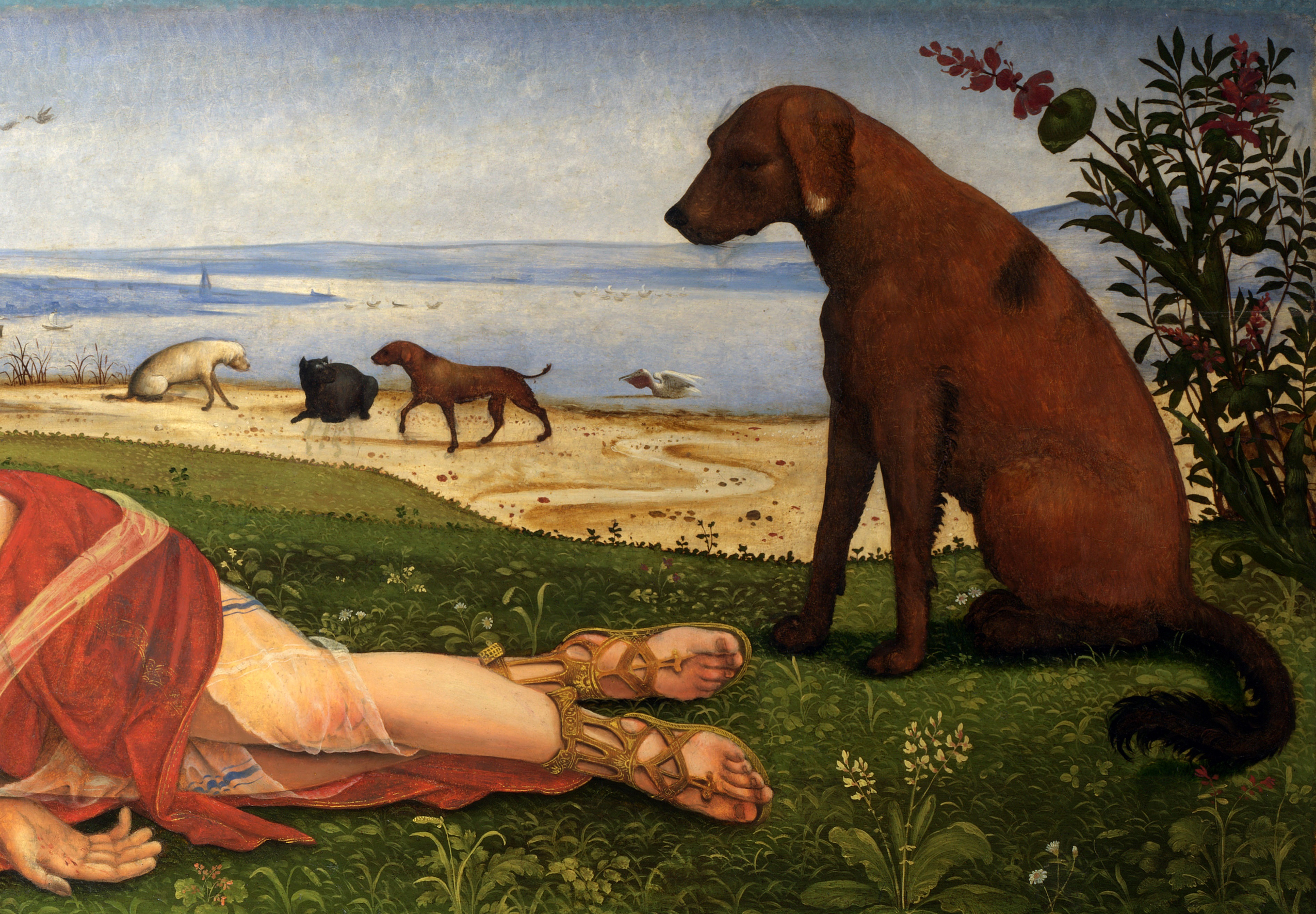
A Satyr mourning over a Nymph (The Death of Procris)
Circa 1495
Oil on poplar wood
65 x 184 cm
National Gallery, London
https://www.nationalgallery.org.uk/paintings/piero-di-cosimo-a-satyr-mourning-over-a-nymph

In Greek mythology, Procris was an Athenian princess as the third daughter of Erechtheus, king of Athens and his wife, Praxithea, daughter of Phrasimus and Diogeneia. Homer mentions her in the Odyssey as one of the many dead spirits Odysseus saw in the Underworld, and Sophocles wrote a tragedy called Procris which has been lost, as has a version contained in the Greek Cycle, but at least six different accounts of her story still exist.

https://en.wikipedia.org/wiki/Procris


Monday, September 26, 2022

Maerten van Heemskerck
(1498 - 1574)

Maarten van Heemskerck or Marten Jacobsz Heemskerk van Veen (1 June 1498 - 1 October 1574) was a Dutch portrait and religious painter, who spent most of his career in Haarlem. He was a pupil of Jan van Scorel, and adopted his teacher's Italian-influenced style. He spent the years 1532–6 in Italy. He produced many designs for engravers, and is especially known for his depictions of the Wonders of the World.

https://en.wikipedia.org/wiki/Maarten_van_Heemskerck

Panorama with the Abduction of Helen Amidst the Wonders of the Ancient World
1535
Oil on canvas
147 x 383 cm
Walters Art Museum, Baltimore
https://art.thewalters.org/detail/21286

Heemskerck's interpretation of the narrative, the abduction of Helen, queen of the Greek city-state Sparta, by Paris, a prince of Troy in Asian Minor, an epic that stretches across the ancient world to Rome itself, was influenced by versions of the story that set events among the marvels of heroic achievements of the ancient world. This luminous panorama is one of the most famous Northern landscapes of the 1500s; its array of ancient marvels and evidence of antiquity's greatness provided a picture-puzzle for the viewer, challenging him to locate and identify the pieces. In Greek and Roman literature a rainbow was evidence that the messenger goddess Iris, identified by her multicolored mantle, was on her way to deliver a message. In this story, she alerted Helen's husband Menelaus who was away from home when the abduction took place.


Sunday, September 25, 2022

 Giovanni Panini
(1691 - 1765)

Giovanni Paolo Panini or Pannini was an Italian painter and architect who worked in Rome and is primarily known as one of the vedutisti ("view painters"). As a painter, Panini is best known for his vistas of Rome, in which he took a particular interest in the city's antiquities. Among his most famous works are his view of the interior of the Pantheon (on behalf of Francesco Algarotti), and his vedute—paintings of picture galleries containing views of Rome. Most of his works, especially those of ruins, have a fanciful and unreal embellishment characteristic of capriccio themes. In this they resemble the capricci of Marco Ricci. Panini also painted portraits, including one of Pope Benedict XIV.
 
https://en.wikipedia.org/wiki/Giovanni_Paolo_Panini


The abduction of Helen
Date unknown
Oil on canvas
Private collection 
(Sold by Sotheby’s in 2015)
https://www.sothebys.com/en/auctions/ecatalogue/2015/master-paintings-part-i-n09302/lot.95.html
 
Married to King Menelaus of Sparta, the demi-goddess Helen was the daughter of Zeus and Leda, and according to Greek mythology, the most beautiful woman in the world.  Panini here depicts the moment in which Helen is abducted by Paris, the episode that would trigger the Trojan War.

Saturday, September 24, 2022

 Paul Cézanne
(1839 - 1906)

Paul Cézanne was a French artist and Post-Impressionist painter whose work laid the foundations of the transition from the 19th-century conception of artistic endeavour to a new and radically different world of art in the 20th century. Cézanne is said to have formed the bridge between late 19th-century Impressionism and the early 20th century's new line of artistic enquiry, Cubism.

https://en.wikipedia.org/wiki/Paul_Cézanne

Leda and the Swan 
Circa 1880 
Oil on canvas 
59,7 x 74,9 cm 
The Barnes Foundation, Philadelphia

https://collection.barnesfoundation.org/objects/6991/Leda-and-the-Swan-(Leda-au-cygne)/

This picture is unusual in Cézanne's oeuvre for its specific literary subject matter. It represents the story from Ovid's Metamorphoses in which Zeus disguises himself as a swan to seduce Leda, the daughter of King Thestius. This is certainly one of the artist's more overtly sensual paintings: Leda displays herself for the viewer, hip curving dramatically and cheeks flushed, while the swan's beak wraps around her wrist as if taking possession of her. Cézanne made two drawings in preparation for the painting, one of which shows the figure holding a champagne flute.

Friday, September 23, 2022

 Gustave Moreau
(1826 - 1898)
 
Gustave Moreau was a French artist and an important figure in the Symbolist movement. Jean Cassou called him "the Symbolist painter par excellence". He was an influential forerunner of symbolism in the visual arts in the 1860s, and at the height of the symbolist movement in the 1890s, he was among the most significant painters. Art historian Robert Delevoy wrote that Moreau "brought symbolist polyvalence to its highest point in Jupiter and Semele." He was a prolific artist who produced over 15,000 paintings, watercolors, and drawings. Moreau painted allegories and traditional biblical and mythological subjects favored by the fine art academies. J. K. Huysmans wrote, "Gustave Moreau has given new freshness to dreary old subjects by a talent both subtle and ample: he has taken myths worn out by the repetitions of centuries and expressed them in a language that is persuasive and lofty, mysterious and new."The female characters from the Bible and mythology that he so frequently depicted came to be regarded by many as the archetypical symbolist woman. His art (and symbolism in general) fell from favor and received little attention in the early 20th century but, beginning in the 1960s and 70s, he has come to be considered among the most paramount of symbolist painters. 
 
https://en.wikipedia.org/wiki/Gustave_Moreau


Oedipus and the Sfinx
1864
Oil on canvas
206 x 104 cm
Metropolitan Museum of Art
https://www.metmuseum.org/art/collection/search/437153
 
The legendary Greek prince Oedipus confronts the malevolent Sphinx, who torments travelers with a riddle: What creature walks on four legs in the morning, two legs at noon, and three legs in the evening? Remains of victims who answered incorrectly litter the foreground. (The solution is the human, who crawls as a baby, strides upright in maturity, and uses a cane in old age.) Moreau made his mark with this painting at the Paris Salon of 1864. Despite the growing prominence of depictions of everyday life, he portrayed stories from the Bible, mythology, and his imagination. His otherworldly imagery inspired many younger artists and writers, including Odilon Redon and Oscar Wilde

Thursday, September 22, 2022

Odilon Redon
(1840 - 1916)

Odilon Redon was a French symbolist painter, printmaker, draughtsman and pastellist.
Early in his career, both before and after fighting in the Franco-Prussian War, he worked almost exclusively in charcoal and lithography, works referred to as noirs. He started gaining recognition after his drawings were mentioned in the 1884 novel À rebours (Against Nature) by Joris-Karl Huysmans. During the 1890s he began working in pastel and oils, which quickly became his favourite medium, abandoning his previous style of noirs completely after 1900. He also developed a keen interest in Hindu and Buddhist religion and culture, which increasingly showed in his work.
He is perhaps best known today for the "dreamlike" paintings created in the first decade of the 20th century, which were heavily inspired by Japanese art and which, while continuing to take inspiration from nature, heavily flirted with abstraction. His work is considered a precursor to both Dadaism and Surrealism.


https://en.wikipedia.org/wiki/Odilon_Redon


The Cyclops
Circa 1914
Oil on cardboard mounted on panel
65,8 x 52,7 cm
Köller-Müller Museum, Otterloo
https://krollermuller.nl/en/odilon-redon-the-cyclops-1

In this painting, the Cyclops Polyphemus spies on the sleeping Nereid Galathea from behind a tall mountain. The one-eyed giant’s love remains unrequited, as Galathea prefers the river god Acis. The unnaturally large eye is the most conspicuous part of the painting. In Redon’s work, the eye is often an all controlling, independent creature, a symbol of the human soul and of the mysterious, unknown inner world.

  William Holman Hunt (2 April 1827 – 7 September 1910)   William Holman Hunt  was an English painter and one of the founders of the Pre-Rap...