Friday, September 30, 2022

Edward Burne-Jones
(1634 - 1705)

Sir Edward Coley Burne-Jones, 1st Baronet, ARA was a British painter and designer associated with the Pre-Raphaelite Brotherhood which included Dante Gabriel Rossetti, John Millais, Ford Madox Brown and Holman Hunt. Burne-Jones worked with William Morris as a founding partner in Morris, Marshall, Faulkner & Co in the design of decorative arts. 
https://en.wikipedia.org/wiki/Edward_Burne-Jones


The Wine of Circe
Watercolour and bodycolour on paper
1863 - 1869
Dimensions: 70 cm x 101.5 cm
Private Collection
https://www.eb-j.org/browse-artwork-detail/MTI2MA==

Circe is an enchantress and a minor goddess in ancient Greek mythology and religion. She is either a daughter of the Titan Helios and the Oceanid nymph Perse or the goddess Hecate and Aeëtes. Circe was renowned for her vast knowledge of potions and herbs. Through the use of these and a magic wand or staff, she would transform her enemies, or those who offended her, into animals.
https://en.wikipedia.org/wiki/Circe

Thursday, September 29, 2022

 Luca Giordano
(1634 - 1705)
 
Luca Giordano (18 October 1634 – 3 January 1705)[1] was an Italian late-Baroque painter and printmaker in etching. Fluent and decorative, he worked successfully in Naples and Rome, Florence, and Venice, before spending a decade in Spain.

https://en.wikipedia.org/wiki/Luca_Giordano


Perseus turning Phineas and his Followers to Stone
Circa 1660
Oil on canvas
285 x 366 cm
The National Gallery
https://www.nationalgallery.org.uk/paintings/luca-giordano-perseus-turning-phineas-and-his-followers-to-stone
In Greek mythology, Perseus  is the legendary founder of Mycenae and of the Perseid dynasty. He was, alongside Cadmus and Bellerophon, the greatest Greek hero and slayer of monsters before the days of Heracles. He beheaded the Gorgon Medusa for Polydectes and saved Andromeda from the sea monster Cetus. He was the son of Zeus and the mortal Danaë, as well as the half-brother and great-grandfather of Heracles (as they were both children of Zeus, and Heracles' mother was descended from Perseus). 

https://en.wikipedia.org/wiki/Perseus


Wednesday, September 28, 2022

 Giuseppe Bottani
(1717 - 1784)

Giuseppe Bottani  was an Italian painter active in the Baroque period. He was born in Cremona, and lived as a boy in Pontremoli. He was sent to study in Florence, where he was a pupil of Vincenzo Meucci and Antonio Puglieschi. He moved to Rome to work under Agostino Masucci, then he returned to Cremona after 1745. In 1769, he was named professor of painting and director of the Academy of Fine Arts in Mantua. He was known for painting landscapes in the style of Gaspard Poussin, and figures in the style of Maratta.

https://en.wikipedia.org/wiki/Giuseppe_Bottani


Athena appearing to Odysseus to reveal the Island of Ithaca
Before 1775
Oil on canvas
Private collection (sold by Sotheby’s 2012)
http://www.sothebys.com/en/auctions/ecatalogue/2012/important-old-master-paintings-n08825/lot.153.html

This painting appears to be a study for:


Athena appearing to Odysseus to reveal the Island of Ithaca
1775
Oil on canvas
Museo Civico, Pavia
https://museicivici.comune.pv.it/site/home/i-musei.html

Tuesday, September 27, 2022

Piero di Cosimo
(1462 - 1522)
 
Piero di Cosimo  also known as Piero di Lorenzo, was an Italian painter of the Renaissance.
He is most famous for the mythological and allegorical subjects he painted in the late Quattrocento; he is said to have abandoned these to return to religious subjects under the influence of Savonarola, the preacher who exercised a huge sway in Florence in the 1490s, and had a similar effect on Botticelli. The High Renaissance style of the new century had little influence on him, and he retained the straightforward realism of his figures, which combines with an often whimsical treatment of his subjects to create the distinctive mood of his works. 
 
https://en.wikipedia.org/wiki/Piero_di_Cosimo


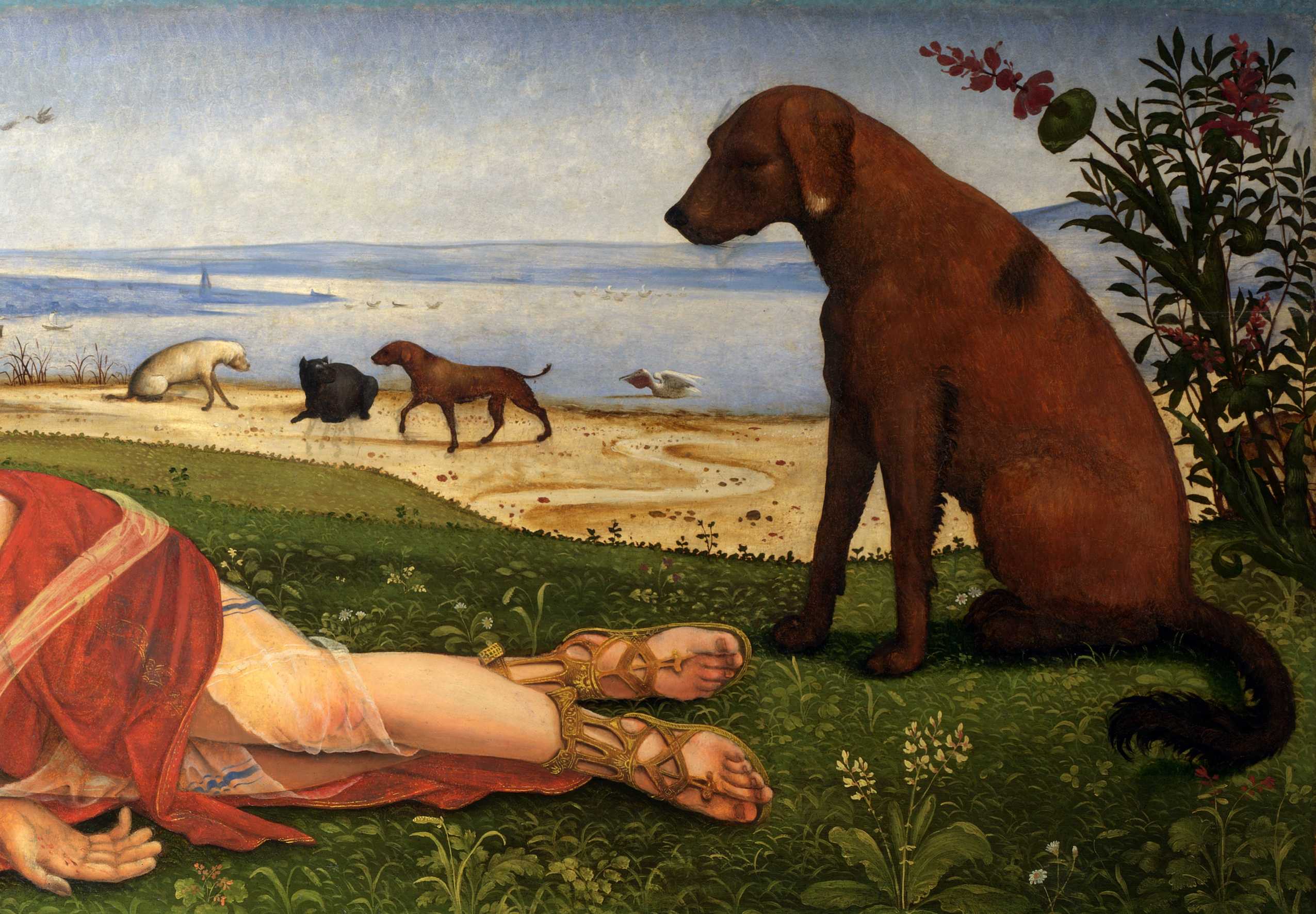
A Satyr mourning over a Nymph (The Death of Procris)
Circa 1495
Oil on poplar wood
65 x 184 cm
National Gallery, London
https://www.nationalgallery.org.uk/paintings/piero-di-cosimo-a-satyr-mourning-over-a-nymph

In Greek mythology, Procris was an Athenian princess as the third daughter of Erechtheus, king of Athens and his wife, Praxithea, daughter of Phrasimus and Diogeneia. Homer mentions her in the Odyssey as one of the many dead spirits Odysseus saw in the Underworld, and Sophocles wrote a tragedy called Procris which has been lost, as has a version contained in the Greek Cycle, but at least six different accounts of her story still exist.

https://en.wikipedia.org/wiki/Procris


Monday, September 26, 2022

Maerten van Heemskerck
(1498 - 1574)

Maarten van Heemskerck or Marten Jacobsz Heemskerk van Veen (1 June 1498 - 1 October 1574) was a Dutch portrait and religious painter, who spent most of his career in Haarlem. He was a pupil of Jan van Scorel, and adopted his teacher's Italian-influenced style. He spent the years 1532–6 in Italy. He produced many designs for engravers, and is especially known for his depictions of the Wonders of the World.

https://en.wikipedia.org/wiki/Maarten_van_Heemskerck

Panorama with the Abduction of Helen Amidst the Wonders of the Ancient World
1535
Oil on canvas
147 x 383 cm
Walters Art Museum, Baltimore
https://art.thewalters.org/detail/21286

Heemskerck's interpretation of the narrative, the abduction of Helen, queen of the Greek city-state Sparta, by Paris, a prince of Troy in Asian Minor, an epic that stretches across the ancient world to Rome itself, was influenced by versions of the story that set events among the marvels of heroic achievements of the ancient world. This luminous panorama is one of the most famous Northern landscapes of the 1500s; its array of ancient marvels and evidence of antiquity's greatness provided a picture-puzzle for the viewer, challenging him to locate and identify the pieces. In Greek and Roman literature a rainbow was evidence that the messenger goddess Iris, identified by her multicolored mantle, was on her way to deliver a message. In this story, she alerted Helen's husband Menelaus who was away from home when the abduction took place.


Sunday, September 25, 2022

 Giovanni Panini
(1691 - 1765)

Giovanni Paolo Panini or Pannini was an Italian painter and architect who worked in Rome and is primarily known as one of the vedutisti ("view painters"). As a painter, Panini is best known for his vistas of Rome, in which he took a particular interest in the city's antiquities. Among his most famous works are his view of the interior of the Pantheon (on behalf of Francesco Algarotti), and his vedute—paintings of picture galleries containing views of Rome. Most of his works, especially those of ruins, have a fanciful and unreal embellishment characteristic of capriccio themes. In this they resemble the capricci of Marco Ricci. Panini also painted portraits, including one of Pope Benedict XIV.
 
https://en.wikipedia.org/wiki/Giovanni_Paolo_Panini


The abduction of Helen
Date unknown
Oil on canvas
Private collection 
(Sold by Sotheby’s in 2015)
https://www.sothebys.com/en/auctions/ecatalogue/2015/master-paintings-part-i-n09302/lot.95.html
 
Married to King Menelaus of Sparta, the demi-goddess Helen was the daughter of Zeus and Leda, and according to Greek mythology, the most beautiful woman in the world.  Panini here depicts the moment in which Helen is abducted by Paris, the episode that would trigger the Trojan War.

Saturday, September 24, 2022

 Paul Cézanne
(1839 - 1906)

Paul Cézanne was a French artist and Post-Impressionist painter whose work laid the foundations of the transition from the 19th-century conception of artistic endeavour to a new and radically different world of art in the 20th century. Cézanne is said to have formed the bridge between late 19th-century Impressionism and the early 20th century's new line of artistic enquiry, Cubism.

https://en.wikipedia.org/wiki/Paul_Cézanne

Leda and the Swan 
Circa 1880 
Oil on canvas 
59,7 x 74,9 cm 
The Barnes Foundation, Philadelphia

https://collection.barnesfoundation.org/objects/6991/Leda-and-the-Swan-(Leda-au-cygne)/

This picture is unusual in Cézanne's oeuvre for its specific literary subject matter. It represents the story from Ovid's Metamorphoses in which Zeus disguises himself as a swan to seduce Leda, the daughter of King Thestius. This is certainly one of the artist's more overtly sensual paintings: Leda displays herself for the viewer, hip curving dramatically and cheeks flushed, while the swan's beak wraps around her wrist as if taking possession of her. Cézanne made two drawings in preparation for the painting, one of which shows the figure holding a champagne flute.

 Gustave Caillebotte (1848 - 1894)   Gustave Caillebotte  was a French painter who was a member and patron of the Impressionists, although h...